
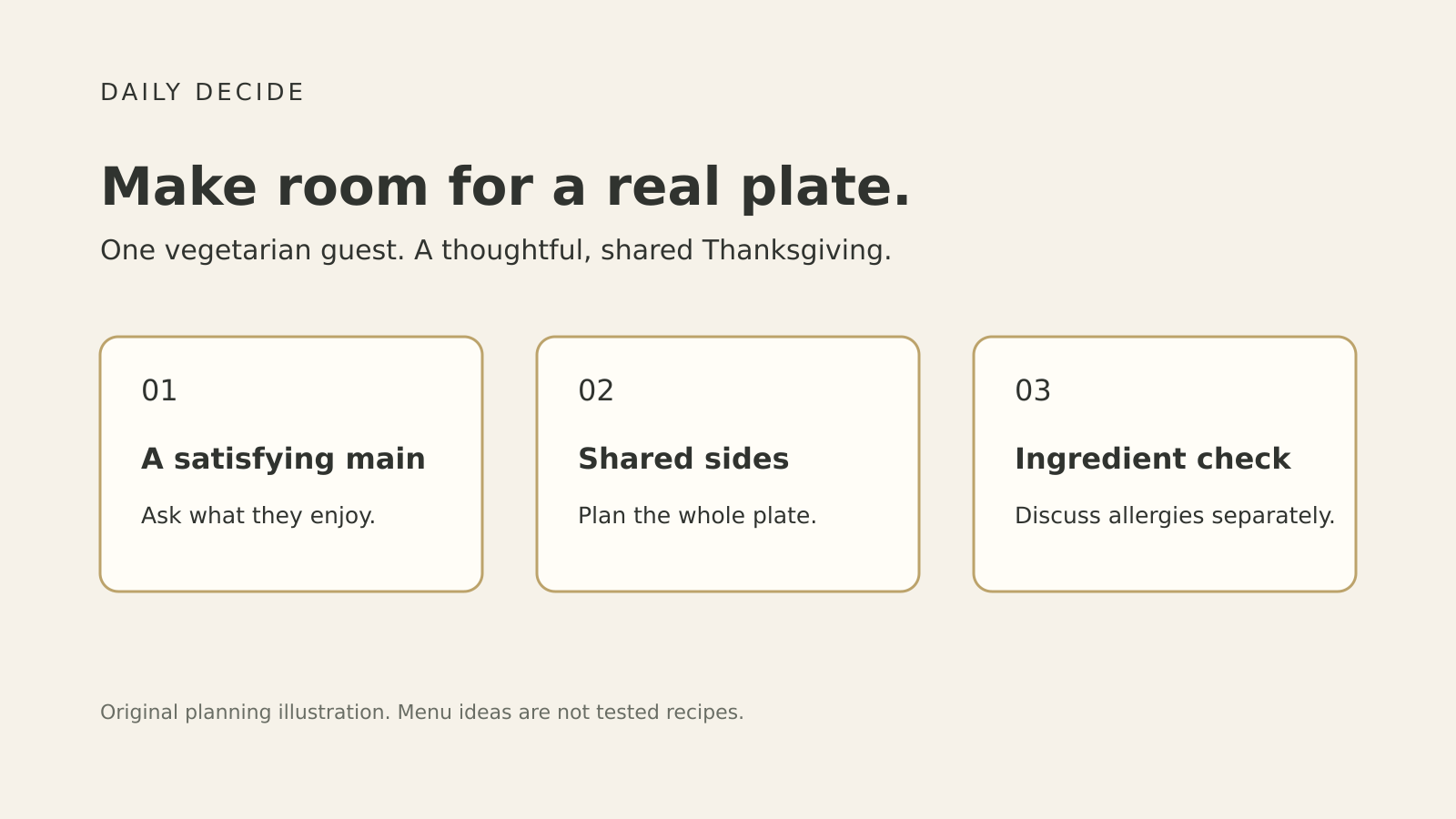
One vegetarian guest shouldn’t have to build dinner out of a roll, a scoop of cranberry sauce and whatever escaped the bacon. You also don’t need to cook a second Thanksgiving from scratch. Start with one main they’ll look forward to eating, then make sure a few shared sides work with it.
The useful question isn’t “What can they pick around?” It’s “What will their plate actually look like?” Answer that before the shopping trip, and the rest becomes much easier.
Ask before you plan
Vegetarian and vegan aren’t interchangeable. Some vegetarians eat eggs and dairy; vegans avoid animal products. Ask your guest what they eat rather than deciding from the label alone. MedlinePlus explains the common distinctions.
Keep it practical: “Are eggs and dairy okay? Is there anything else you avoid? What would you enjoy as a main?” You don’t need them to defend their choices, and you don’t need to announce the conversation to the whole table.
Ask about food allergies separately. A dietary preference and an allergy aren’t the same thing, though someone can have both. If allergies are involved, discuss ingredients, preparation and what your kitchen can realistically accommodate. A vegetarian label or a separate spoon does not establish allergy safety. The FDA explains food allergens and cross-contact.
Choose the main first
Pick something substantial enough to be the center of dinner, not a garnish that has been promoted at the last minute. A bean-filled baked potato, a lentil-and-vegetable pie or stuffed squash could anchor the plate. These are menu ideas, not recipes tested by Daily Decide.
For a complete recipe, Love and Lemons’ stuffed acorn squash is one option to review with your guest. Its ingredients include feta, pecans and pepitas. Follow the publisher’s method, and check the actual products you buy against your guest’s needs. Don’t assume the original version suits a vegan guest or anyone with an allergy.
You don’t have to make a showpiece. If your guest already loves a particular vegetarian casserole, ask for the recipe or agree on a prepared option. Check its ingredient list, cooking directions and oven needs before committing.
If other people will want a taste, plan for that too. The only vegetarian main shouldn’t disappear before the person relying on it reaches the buffet.
Check the ingredients in the shared sides
A dish can look meatless and still contain ingredients your guest avoids. Look at the recipe and the package, not just the dish’s name.
- Stuffing and rice: Check the broth, sausage and any meat drippings.
- Gravy: Check both the base and the mix. Mushroom gravy still needs an ingredient check.
- Vegetables: Bacon, pancetta and cooking fat may already be mixed in. Picking off a topping isn’t the same as preparing a portion without it.
- Potatoes and casseroles: Butter, milk, cream, cheese and eggs matter if your guest avoids them.
- Dessert: Check gelatin, marshmallows and pastry ingredients. Gelatin is excluded by the American Vegetarian Association’s vegetarian standard.
Keep packaging or take a clear ingredient-label photo until dinner is over. If a cheese label leaves its rennet source unclear and that matters to your guest, check with the producer or choose a product whose labeling answers the question.
Sometimes the easiest adjustment is making the shared vegetable dish without bacon and serving bacon separately. Other times, a small separate batch makes more sense. Decide before cooking, while the ingredients are still separate.
Picture the whole plate
Try one of these combinations as a starting point, then check every recipe and product:
A familiar Thanksgiving plate: Stuffed squash, mashed potatoes, green beans and cranberry sauce, with a gravy your guest can eat.
A simpler plate: A bean-filled baked potato, roasted vegetables and a salad with dressing on the side.
A comfort-food plate: A lentil-and-vegetable pie alongside two shared vegetable dishes.
For a vegan guest, choose recipes and products without eggs, dairy or other animal ingredients rather than treating “leave off the cheese” as a universal fix. Include dessert in the conversation, too. It doesn’t need to be elaborate, but it’s easy to overlook until everyone else is cutting pie.
Give the meal a place in the schedule
Write the main into your cooking plan with its actual recipe instructions, oven temperature and serving time. Don’t promise the oven will be free without checking what’s already going into it.
Agree on any preparation and serving boundaries your guest requests. Use separate serving utensils for the appropriate dishes and keep them with those dishes. Tell helpers which gravy or stuffing is which. Clear labels save your guest from asking the same question three times.
If your guest offers to bring food, accept without making it a condition of being included. Confirm whether it arrives ready to serve, needs refrigerator space or requires heating. You can coordinate that part without turning the whole visit into a catering assignment.
Two messages you can send
Host to guest
“I’m planning Thanksgiving dinner and want you to have a proper meal. Do you eat eggs and dairy, and is there anything else you avoid? I’m thinking about a vegetarian main plus a few shared sides. What would you enjoy? Please tell me separately about any allergies or preparation needs so we can talk through what works.”
Guest to host
“Thanks for checking! I eat [foods] and avoid [ingredients]. [Main idea] sounds lovely. Could you check the broth and gravy ingredients too? I’m happy to bring [dish] if that helps, but let’s coordinate so we don’t double up. It would need [serving or heating needs].”
Put the plan on one page
Use the menu and ingredient-check sheet to record the agreed main, shared sides, dessert and any ingredient questions still open. Add who is making each dish and what needs kitchen space.
Once those details are settled, let the guest be a guest. You can point out their choices quietly, put the food on the table and get on with Thanksgiving.
Download the menu planning sheet
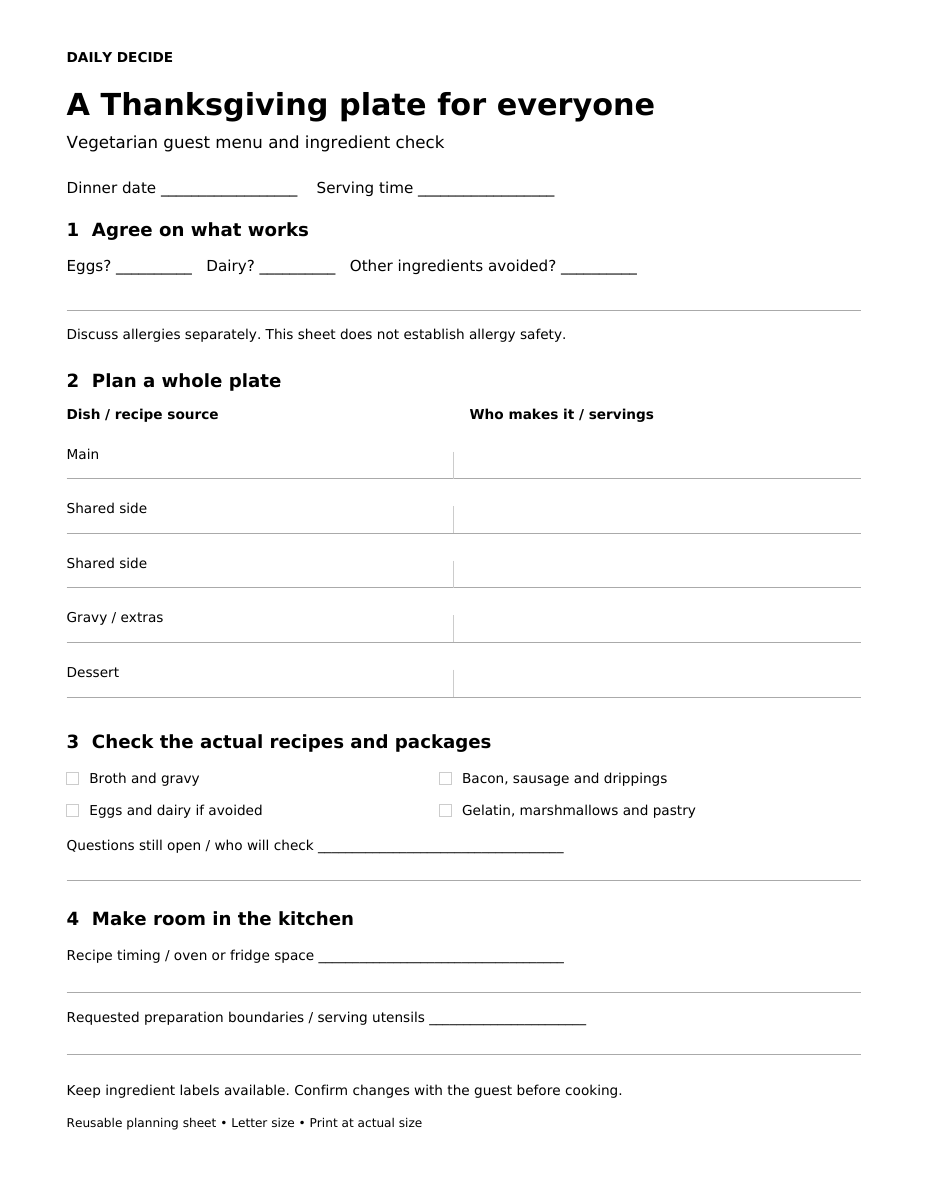
Download the free vegetarian menu and ingredient-check sheet (PDF)
Print this one-page US Letter worksheet and fill it in by hand. It supports a conversation with your guest, not an allergy-safety certification. No physical print test is claimed.
Sources checked November 2, 2026. Menu combinations are planning ideas, not recipes tested by Daily Decide.