
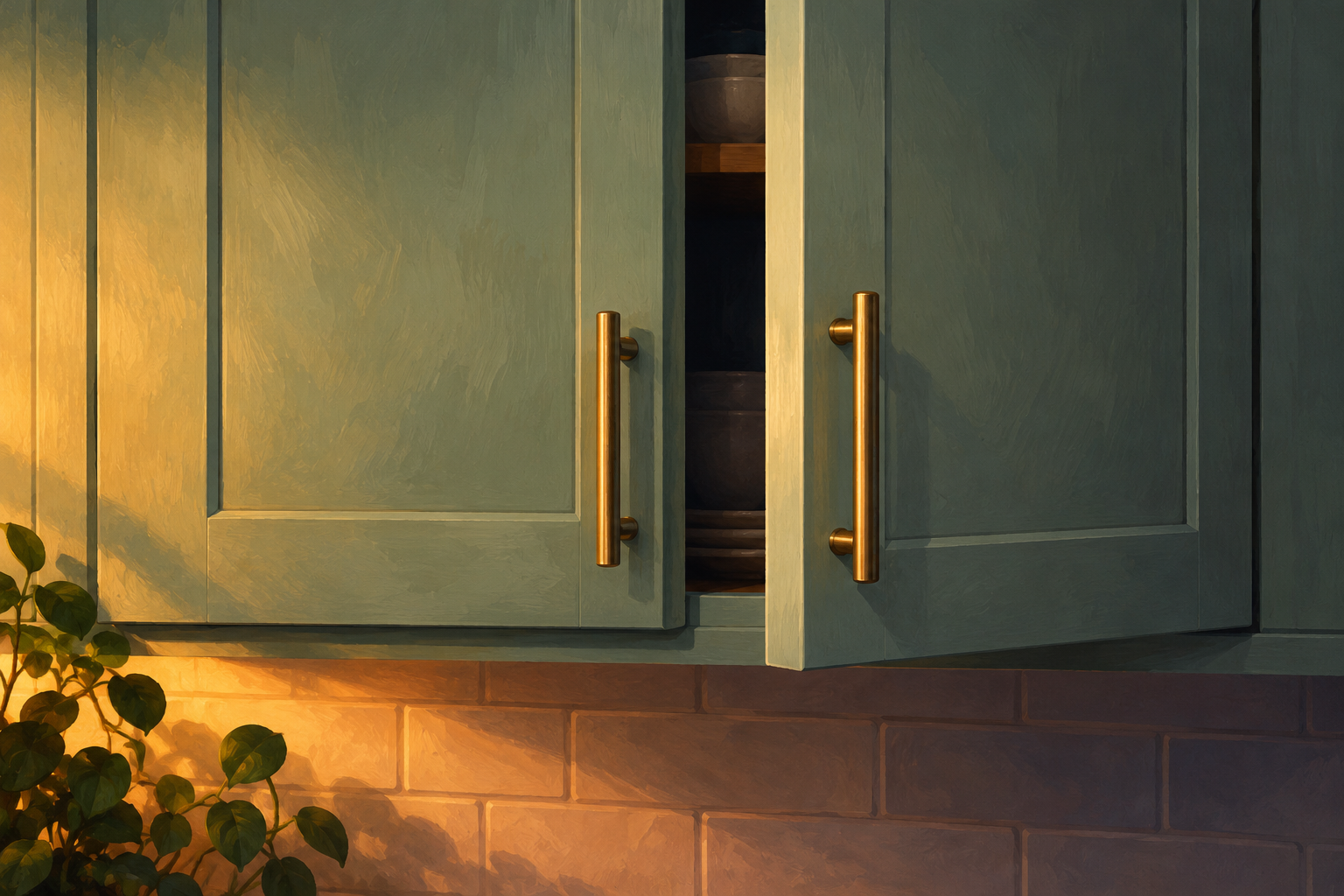
Yes, you can often quiet cabinet doors while keeping the doors themselves. The right purchase depends on what bothers you: the sharp tap when a door meets the cabinet, or a door that swings shut too quickly.
Adhesive bumpers cushion contact. Add-on dampers can slow the final closing movement while leaving compatible hinges in place. Replacement soft-close hinges build that damping into the hinge. Before buying a kitchen’s worth of anything, work out which problem you actually have.
First check why the door is noisy
Close one door gently and watch where it touches. If it rubs another door, sits crooked, or has loose or damaged hardware, deal with that fit problem first. A cushioning pad or damper should not be used to hide a failing attachment.
If your hinges already have soft-close hardware, identify the model and check its adjustment instructions before replacing it. Some systems have a damping switch, including the Salice Silentia+ Series 700.
Adhesive bumpers for a softer landing
Small stick-on cabinet bumpers are worth considering when the door closes normally but makes an irritating tap at contact. Their flexible material absorbs impact; 3M describes its Scotch cabinet bumpers as noise-reducing pads for finished hard surfaces.
They do not control the door’s swing or turn an ordinary hinge into a soft-close hinge. A fast-moving door can still close abruptly, even if the final sound is less sharp.
Check the pad’s dimensions and surface instructions. Place it where the door actually meets the cabinet, and confirm that the added thickness does not leave it sticking out farther than neighboring doors. If you rent, do not assume adhesive automatically means damage-free removal; check permission and finish suitability.
Add-on dampers when you want to keep the hinges
A damper is the next category to investigate if the door needs to slow down before contact. Some fit onto a particular hinge; other designs mount separately inside the cabinet. Salice’s damper range illustrates these different attachment approaches.
Compatibility is the catch. For example, Blum’s H006 add-on instructions specify certain straight-arm CLIP and CLIP top hinges with a square opening in the hinge arm. A similar-looking hinge is not enough to establish a match.
For a separately mounted damper, verify the approved cabinet construction, door application, mounting clearance, and hinge requirements. Do not assume a product advertised for overlay doors also works on inset doors.
These devices can add a gentler closing action, but they do not repair misalignment or damaged hinges. Follow the maker’s guidance on adjustment and quantity. Blum recommends a trial application because the number of add-ons depends on door size and weight.
Soft-close hinges when a compatible replacement makes sense
Replacing the hinges can preserve your doors while adding an integrated damper. It is worth considering when no suitable add-on is confirmed, provided the replacement matches the existing door and cabinet.
The words “soft close” do not tell you whether it fits. Blum COMPACT BLUMOTION is designed for face-frame cabinets and has different overlay versions. Salice Silentia+ Series 100 has distinct full-overlay, half-overlay, and inset variants, plus mounting-plate requirements.
Matching the round hinge-cup diameter alone is not sufficient. Cup depth, screw locations, door thickness, mounting plate, and opening clearance also matter. If the conversion requires new cup holes or substantial drilling, ask a cabinet installer to assess it rather than treating it as a simple swap.
Check these details before buying
Frame style and door position are separate questions. A full-overlay door does not, by itself, tell you whether the cabinet is frameless.
- Cabinet construction: face-frame cabinets have a frame around the opening; frameless cabinets do not.
- Door position: overlay doors cover the opening’s edges; inset doors sit within the opening. Measure the actual overlay rather than guessing from appearance.
- Existing hardware: photograph the hinge, mounting plate, and any model markings.
- Installation requirements: compare those details with the manufacturer’s drawings, including door thickness and clearances.
Choose bumpers for contact noise, investigate a confirmed compatible damper for slower closing, or consider matched replacement hinges for integrated soft close. Try the chosen solution on one door before committing to the rest of the kitchen.
Planning another small cabinet update? See how to replace cabinet handles without drilling new holes, or check whether an under-sink organizer will fit around your pipes and hinges before choosing storage.