
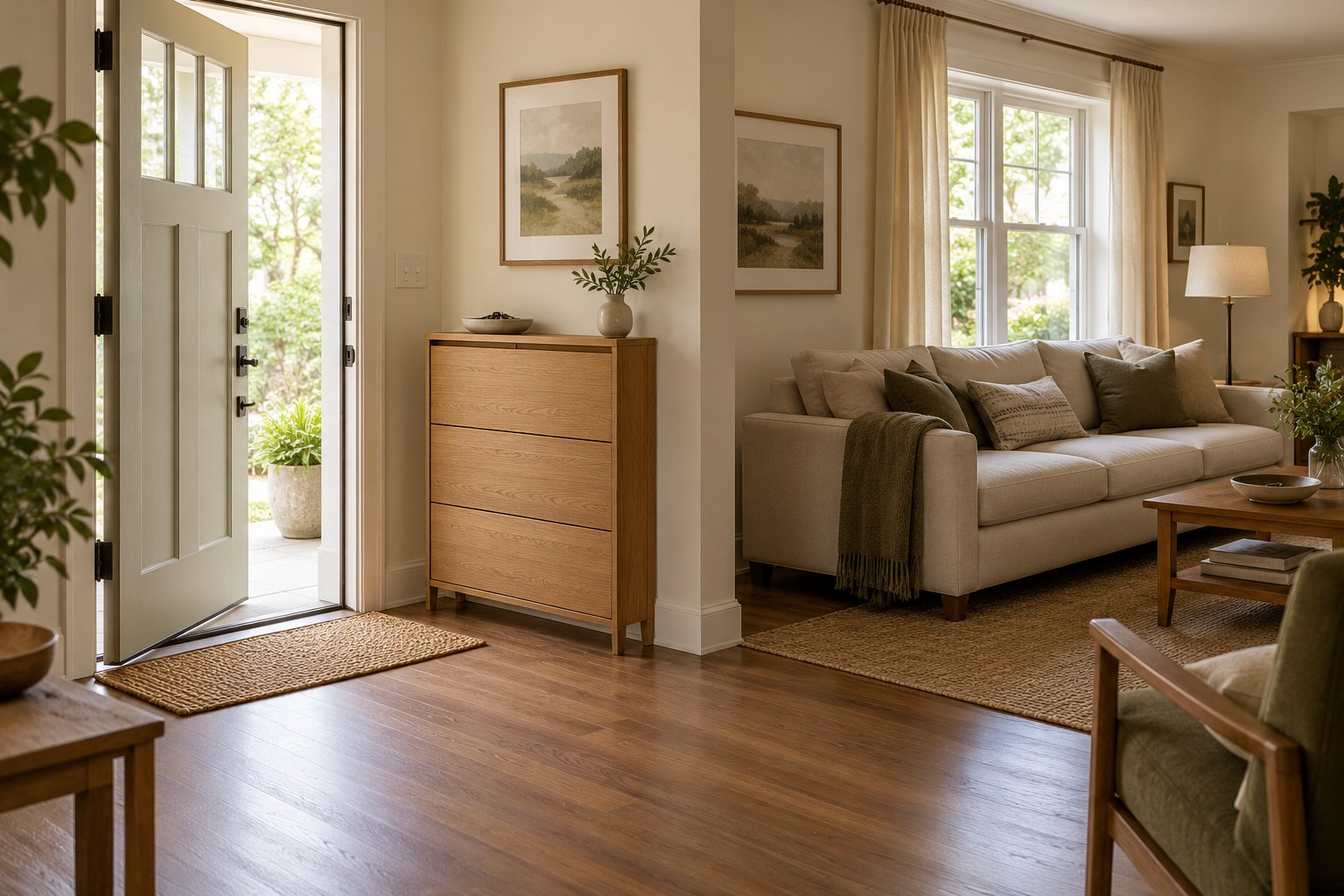
Illustration: AI-generated room concept. Furniture shown is illustrative, not exact product recommendations.
The quick answer
Choose your setup around what lands by the door. A slim console works for keys and mail. A closed shoe cabinet makes sense when shoes are the main clutter. A bench with hooks suits a routine that needs a seat and a place for coats. If furniture crowds the route into your living room, skip it and give everyday items a home elsewhere.
Start with the smallest setup that solves your actual problem. You do not need to squeeze a complete mudroom into a living room.
Choose your entryway setup
| Setup | Choose it when | Main tradeoff |
|---|---|---|
| Slim console | You need a landing spot for small items | An open top can become a pile of mail |
| Closed shoe cabinet | Visible shoes bother you most | Doors or tilt-out compartments need opening room |
| Bench and hooks | You want to sit to put shoes on and hang everyday layers | The seat and hooks can fill with bags and clothing |
| No new furniture | The entrance is tight or nearby storage already works | You need a consistent habit of putting things away |
Measure before you shop
Write down the usable wall width, the depth you can spare, and anything that interrupts the wall, including baseboards, outlets, switches, and vents. Then check how the space works in motion:
- Open the front door through its normal range. Note the handle as well as the door edge.
- Outline a possible furniture footprint with floor-safe tape, checking the finish before using it.
- Walk from the entrance to the sofa and adjoining rooms carrying your usual bags.
- Allow room to open drawers, cabinet doors, or tilt-out compartments. Check the product’s open dimensions, not just its closed depth.
- For a bench, test where your feet and knees would go while seated.
- Include protruding handles and hanging coats or bags in your plan.
Do not treat a piece that technically fits against the wall as a finished layout. Keep the doorway and route through the room unobstructed, and follow applicable building requirements and the product’s installation instructions.
Three product categories to compare
1. Slim consoles for keys and mail
Best for: a landing spot when shoes and coats already have somewhere to go.
Look for a shallow console with enough top space for a small tray, rather than a surface you will feel obliged to decorate. A drawer can separate keys and sunglasses from incoming mail. An open shelf only helps if you are comfortable seeing what goes there.
Measure and check first: the assembled depth, handle projection, construction materials, care instructions, and any required anchoring. Consider whether the finish suits wet umbrellas or damp items, rather than assuming every wood-look surface can handle them.
The tradeoff: a console alone will not solve shoe and coat storage needs, and an open top needs a limit on incoming mail.
2. Closed shoe cabinets for visible shoe clutter
Best for: keeping shoes out of sight with a realistic limit on how many pairs live here.
Count the pairs you actually keep near the door. Then compare internal compartment dimensions with your largest everyday shoes. A headline capacity figure is less useful if your boots or larger shoes do not fit.
Measure and check first: shelf adjustability, opening clearance, cleaning access, materials, and installation requirements. A shallow tilt-out design may look promising, but check the space it occupies when open and whether wall attachment is required.
The tradeoff: a slim closed footprint does not tell you how much room the cabinet needs when you use it.
3. Benches and hooks for getting out the door
Best for: a routine where sitting and hanging are more important than hiding everything.
A bench earns its space if someone will regularly use the seat. Compare seat dimensions and the manufacturer’s stated weight limit. Check whether lower storage fits your shoes and can be cleaned without an awkward reach.
Measure and check first: the approved mounting surface, fixing method, and load limit for hooks. Plan for the bulk of hanging items, not just the empty hooks.
The tradeoff: the seat and hooks can become overflow storage. Leave enough usable seat space instead of treating the bench as a bag shelf.
Renters and the buy-nothing option
Check your lease or ask your landlord before drilling. Follow required anchoring instructions even if a piece is described as freestanding; do not choose it on the assumption that wall attachment is optional. Removable hooks also have surface and load restrictions, so read their instructions. See the CPSC’s Anchor It! guidance on preventing furniture tip-overs and Command’s surface and weight-limit guidance for its removable hooks.
Before buying anything, try a week with a tray on an existing shelf, everyday shoes in a nearby closet, and coats on storage you already have. Move occasional-use items away from the entrance.
At the end of the week, name the one problem that remains. Buy for that problem, not for an empty wall. If the entrance works better without another piece of furniture, that is your answer.
Your before-you-buy checklist
- I can name the everyday clutter this setup needs to solve.
- I have tested the footprint, door swing, and walking route.
- I have allowed room for opening compartments and using the seat.
- I have checked dimensions, load limits, care, and anchoring instructions.
- I have tried the storage I already own before adding more furniture.