
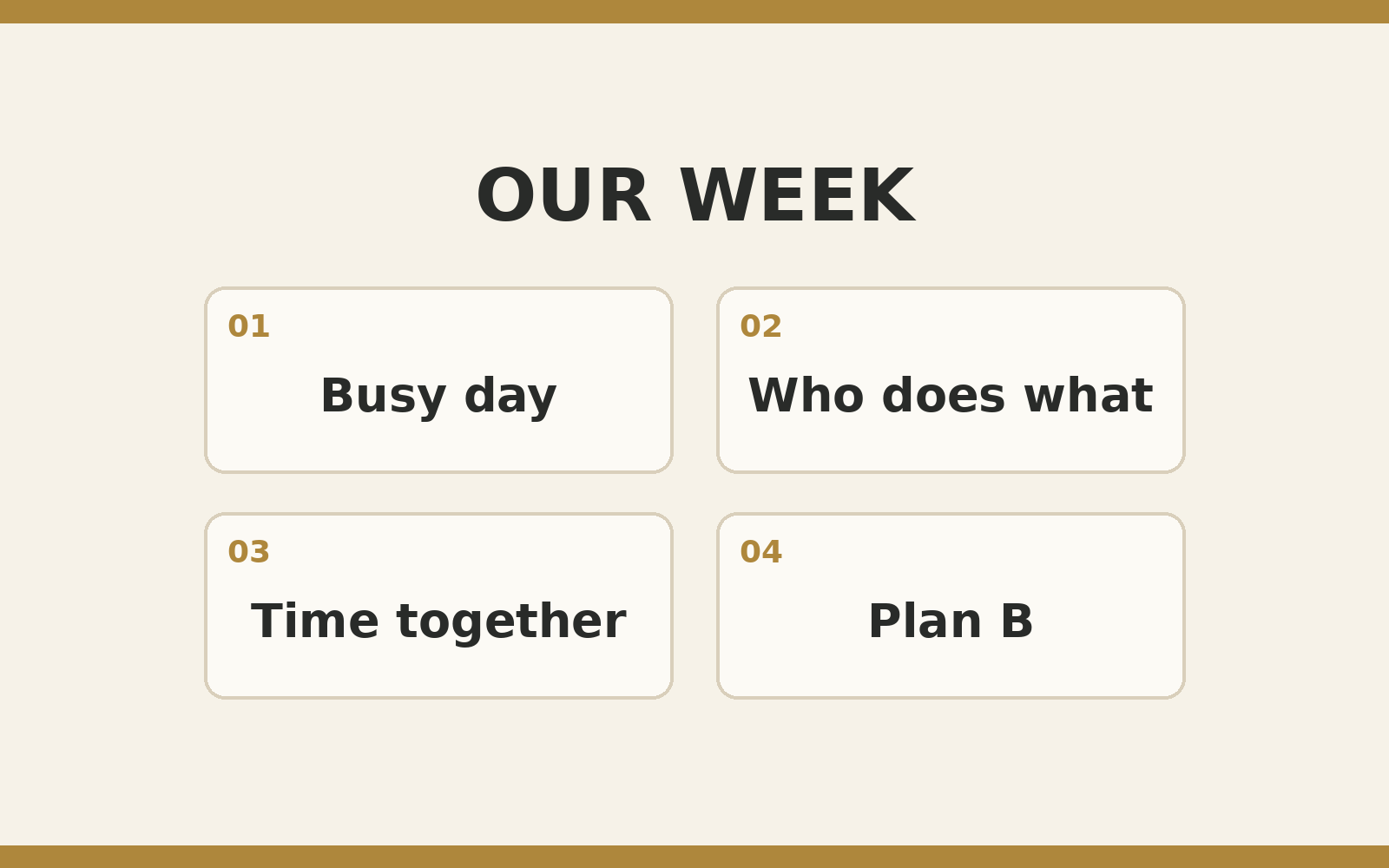
Start here: Choose the week’s busiest day, agree who is doing what, and write down one backup plan. A family check-in does not need to become another event to organize.
Try a ten-minute timer as a boundary, not a test. You can finish early, skip a question or arrange a separate conversation for something that needs more attention. This is a practical planning sheet for the people who share your week, whether that means a partner, children, relatives or a household spread across more than one home.
Before you start: one calendar, one note
Bring whatever already holds your commitments: a paper calendar, phone calendar or list. Use one shared note for the decisions. There is no need to buy a planner, install an app or decorate a chart.
If everyone cannot join at once, send the questions ahead and collect short replies. Make agreements with the people involved rather than assigning them work while they are absent.
Minutes 1–3: What is already fixed?
Each person shares the commitments that affect someone else: a late shift, an appointment, a lift, a delivery window or time they need left free. Include only the detail needed to coordinate. Private appointments can simply be marked “unavailable.”
Look for clashes. Does someone need the car when someone else needs a ride? Is dinner usually started by someone who will be out? Write down the conflict, then choose the next action to resolve it.
Minutes 4–5: Which day needs the easiest plan?
Pick one pressure point instead of planning every hour. Decide what can be made simpler on that day: a meal from food you have, a task moved earlier or a nonessential errand postponed.
For dinner, use the cook-with-what-you-have guide to choose a starting ingredient rather than add another shopping trip.
Minutes 6–7: Who agrees to handle what?
Replace “someone needs to do it” with a named person, a clear task and a useful deadline. Ask what each person can realistically take on. Where children participate, keep choices suited to their abilities and the support available.
“Laundry” is vague. “Put the towels in the wash on Tuesday morning” is easier to understand. Check whether the task also needs supplies, transport or help. If nobody can take it on, simplify, defer or revisit it rather than silently leaving it to one person.
Minutes 8–9: Is there room for something together?
This part is optional. Choose one small thing people actually want to do: a walk, a shared snack or a game you already own. Leaving a night unplanned is also a valid choice.
If you want an activity, try the family game-night guide. For an indoor alternative, keep the rainy-day guide as a backup, not another obligation.
Minute 10: What is Plan B?
Ask: “If the busiest day goes sideways, what can we drop or change?” Agree how to tell each other about a change. End by reading back the decisions, not reopening the entire week.
Copy this weekly check-in sheet
Copy the table into a note or onto paper. A few words in each row are enough.
| Question | Our decision |
|---|---|
| What affects someone else’s schedule? | Commitment, day and coordination needed: |
| Which day needs an easier plan? | Day and one thing to simplify: |
| Who has agreed to each task? | Person, task, deadline and support: |
| Anything we want to do together? | Optional activity, or leave it open: |
| What is our backup? | What can change, and how we will tell each other: |
Decide and done: Keep the note somewhere everyone involved can find it. The aim is a usable next step, not a perfectly controlled week.